If you are simply looking for a method to plan the Winbond SPI display with 'pre-loaded' information that your microcontroller would read for use when it is running then what you will want to appear into will be a developer that can do in-circuit development of the SPI Flash nick. This furthermore recognized as in-systém-programming (ISP). 0ne choice is definitely the. This USB linked device can program in outlet if you style your plank properly.
Designing With Discrete SPI Flash Memory. This is called programming. Much lower than the 80MHz speed of common Serial Flash memory ICs. Microchip's PICkit™ 3 In-Circuit Debugger/Programmer uses in-circuit debugging logic incorporated. Serial and parallel flash memory products are an. Dec 11, 2017 I bought one cheap chinese CH341A serial memory programmer black PCB (see attached picture). Someone already did the schematic of this board (atached). Download Willem EPROM Programmer + schematic + layout. Download Willem EPROM Programmer + schematic + layout. Atmel Flash Memory (Sector Programming).
They also sell an adapter clip that can attach into the Plant-16 package without getting to design and style in a distinct development header on your board. DediProg offers application details bulletins available to help with right design for in routine use. The primary technique for the style is certainly to find a easy way to separate the SPI interface drivers in your MCU system so that they perform not get in the way with the motorists in the SPI programming pod. The simplest way to perform this can be to put series resistors in thé MCU driven lines between the MCU and the SPI Flash.
The programmer would link on the SPI flash side of the collection resistors. Alternative methods could consist of incorporating a MUX or analog goes in the driven interface outlines. An even more smart scheme can be to add a 'coding enable' insight to the MCU that can make the software program detachment all the SPI I/Operating-system from the SPI Flash chip (i.e. Make all those GPIOs as inputs). A 2nd choice to furthermore consider will be.
The Presto is definitely capable to perform various sorts of SPI and I 2C devices including SPI Flash devices. I have one of these products specifically for programming Atmel MCUs and numerous varieties of SPI Flash products.
It is a more cost effective answer than the above unit but not very as flexible. Their more expensive device called the Specialty is able to do more items because it offers more target interface hooks. Sometimes it can end up being helpful to be capable to connect a programmmer to a target board without having to include a programming header.
One great answer for this is usually to spot a little set of parts in a specific footprint described. They produce and market a series of quick connect programming cables that possess pogo pins that employ the unique footprint on the board. There are 6-flag, 10-pin number and 14-pin versions of the wire accessible to match a range of programs. Cost of the wires are extremely fair.
I have never heard of any other tools speaking SPI directly to like a chip, and I think it will be impossible since 'all' chips require different calls for various functions. The nick desires SPI phone calls for write, read through, change field, data size etc. Under 7.2 Instructions section in the datashéet you can notice all the SPI commands you can send out to it. Therefore, since all external flash thoughts does not have got the exact same instruction place, you require to write a customized program for this one.
EDIT: Getting a follow upward, I would really recommend one of Atmels very own SPI display memories, since many of them currently has written open obtainable code for them. Looking at from will provide you with code for some óf Atmels AT45xxxx serial flash chips. I bought a ' programmer from Embedded Computers for about $30 US.
It had been surprisingly easy to connect to the PC via USB and compose documents to the Winbond flash storage. The strategies and programmers in other answers are usually probably simply as good, some even more expensive or DIY, but this is usually a cheap and simple method that matches what I was seeking. Right here's a picture of the set up: The FlashCAT coder is certainly at still left, connected to USB. It'h operating the SPI programming firmware (as opposed to JTAG) and supplying strength to the flash memory space. The provided power is certainly selectable (3.3V or 5V) with a jumper. I possess a SOIC to DIP socket on the breadboard to create it simple to plan multiple potato chips. (You can see another adobe flash memory space IC sitting on the breadboard mainly because properly.) I haven't however converted my sound document to the proper binary format, but I published a 211KN WAV document to memory space just to test, pictured over.
I then learn it back again and stored it as a brand-new file, renamed it tó.wav, ánd it plays correctly on the Personal computer. The next action will be to properly encode the file, and compose the AVR software to go through the data and deliver it through á DAC. Disclaimer: l are not affiliated with Embedded Computer systems, I'michael simply a client who picked something affordable and am posting details about the encounter with the product. Type of late to the debate, but for anyone reading it after a search. One point I did not observe stated, which can be absolutely vital when programming SPI Flash potato chips is control of the Nick Select (CS) flag. The Chip Select flag is used to punctuate instructions to the SPl Flash.
In particular, a changeover from CS high to CS low must instantly precede the issuancé of any Writé procedure op code (WREN, BE, SE, PP). If there is usually action between the CS changeover (i.age. After CS has gone reduced) and before thé write op code is carried, the write op code will generally be ignored. Furthermore, what's not commonly described in SPI FIash datasheets, bécause it'h an inherent component of the SPI protocol, which is also critical, is that for évery byte one sends on the SPI bus, one receives a byte in come back. Furthermore, one cannot get any bytes, unless one sends a byte. Generally, the SPI Get better at that the user is telling, offers a Transmit Buffer, which transmits bytes out ón the MOSI range of the SPI shuttle bus and a Receive Buffer, which gets bytes in fróm the MISO series of the SPI coach.
In purchase for any data to appear in the Receive buffer, some data must have been delivered out the Transmit Barrier. Likewise, any period one transmits data out of the Transmit barrier, data will show up in the Receive Barrier. If one is definitely not careful about levelling Transmit writes and Get reads, one will not understand what to expect in the Receive barrier. If the Receive barrier overflow, data is generally just leaking and lost. Therefore, when one transmits a read command, which is definitely a one byte op code and three deal with bytes, one will very first receive four bytes of 'trash' in the SPI Expert Receive buffer.
These four bytes of garbage correspond to the op program code and three deal with bytes. While those are usually being sent, the Flash will not yet understand what to Read, so it simply profits four terms of crap. After those four words and phrases of junk are came back, in purchase to obtain anything eIse in the Réceive Barrier, you must Transfer an quantity of data similar to the amount that you would like to Read.
After the op code and deal with, it doesn't matter what you transmit, it's simply filler to press the Read through Information from the SPl Flash to thé Receive Buffer. If you didn't maintain careful monitor of those 1st four returned garbage words, you might think that one or more of them is definitely component of your came back Read Data. Therefore, in order to understand what you are usually actually getting from the receive barrier, it's important to understand the dimension of your barrier, understand how to inform whether it's i9000 clear or full (there's i9000 usually sign-up status bit to review this) and keep monitor of how much stuff you've carried and how much you've obtained. Before beginning any SPI Flash operation, it's a good concept to 'pipe' the Receive FIFO. This means check out the position of the receive buffer and unfilled it (usually performed by carrying out a 'go through' of the Receive Barrier) if it will be not already empty.
Generally, draining (reading through) an currently unfilled Receive Buffer does no damage. The right after information is usually obtainable from the time layouts in datasheets óf SPI FIashes, but sometimes folks overlook pieces. All commands and data are released to the SPI flash using the SPI coach. The series to read through a SPI Flash is definitely: 1) Start with CS higher. 2) Bring CS low. 3) Concern 'Read' op code to SPI Flash. 4) Problem three deal with bytes to SPI Flash.
5) 'Receive' four rubbish words in Receive Barrier. 6) Transmit as several arbitrary bytes (don't loves you) as you wish to receive. Number of transmitted bytes after deal with equals size of preferred go through. Bfme2 patch 1.09. 7) Obtain read data in the Receive Barrier.
8) When you've examine the preferred quantity of information, arranged CS higher to end the Read through order. If you skip this stage, any extra transmissions will end up being construed as demand for more information from (a extension of) this Study. Note that methods 6 and 7 must end up being interleaved and repeated based on the size of the réad and the dimension of your Receive and Transmit Buffers. If you Transfer a larger number of words at one go, than your Receive Buffer can keep, you'll leak some information. In purchase to preform a Web page System or Write command execute these methods. Page Size (typically 256 bytes) and Sector Size (typically 64K) and associated boundaries are usually qualities of the SPl Flash you are using.
This details should be in the datashéet for the FIash. I will omit the information of levelling the Transmit ánd Receive buffers.
1) Begin with CS high. 2) Transformation CS to lower. 3) Transmit the Write EnabIe (WREN) op code.
4) Switch CS to higher for at minimum one SPI Coach clock period. This may become tens or 100s of web host clock series. All write procedures do not begin until CS will go high. The previous two information use to all the using 'CS to higher' ways. 5) Change CS to reduced. 6) Gadfly cycle: Transmit the 'Read through from Standing Sign up' (RDSR) op program code and one more byte. Receive two bytes.
Initial byte is garbage. Second byte can be status. Check out position byte. If 'Write in Progress' (WIP) bit is set, repeat loop. (Notice: Might also verify 'Write Enable Latch' little bit is arranged (WEL) after WIP is certainly very clear.) 7) Change CS to higher.
8) Change CS to reduced. 9) Transmit Industry Erase (SE) or Mass Erase (End up being) op program code. If sending SE, after that follow it with three byte deal with.
Download Flashdance (1983) Ita-Eng 720p BluRay x264 [TNT Village] torrent or any other torrent from Highres Movies category. Download Flashdance Torrent at TorrentFunk. We have 97 Flashdance Movie torrents for you! 
10) Change CS to high. 11) Switch CS to reduced. 12) Gadfly loop: Spin on WIP in Status Sign up as above in phase 6. WEL will become unset at finish. 13) Change CS to high. 14) Change CS to reduced. 15) Transmit Write Enable op program code (once again).
16) Switch CS to high. 17) Switch CS to lower. 18) Gadfly cycle: Wait on WIP bit in Status Sign up to clean. (WEL will become set.) 19) Transmit Page Plan (PP = Write) op program code implemented by three deal with bytes. 20) Transmit up to Web page Size (typically 256 bytes) of data to create. (You may enable Receive information to just leak over during this procedure, unless your sponsor hardware offers a issue with that.) 21) Change CS to higher. 22) SWitch CS to lower.
23) Gadfly cycle: Rewrite on WIP in the Position Sign up. 24) Empty Receive FIFO só that it't ready for the following user. 25) Optional: Repeat steps 13 to 24 as required to compose additional web pages or web page segments. Finally, if your write tackle is not on a page border (typically a a number of of 256 bytes) and you compose enough information to mix the adhering to page border, the information that should mix the boundary will be created to the beginning of the page in which your program address falls. So, if you try to write three bytes to tackle 0x0FAge.
Mortal Kombat X Pc Download. Highly Compressed PC Games Free Download Full Version. Home Categories Action Mortal Kombat X Pc Download Free Full Version.  Mortal Kombat is one of the best fighting game available which is loved by many people across the world whereas Mortal Kombat 5 or you can say Mortal Kombat. Mortal Kombat X Full Pc Game Highly Compressed 40MB DownLoaD Mortal Kombat X is a fighting video game. So just DowNLoaD Free Activated Utorrent from below.
Nand Flash Programmer
The first two bytes will become composed to 0x0fe and 0x0fn. The third byte will be created to deal with 0x000. If you transfer a amount of data bytes bigger than a page dimension, the earlies bytes will become discarded and only the last 256 (or web page size) bytes will be utilized to plan the page. As often, not responsible for consequences of any errors, typos, oversights, ór derangement in thé over, nor in how you place it to use. Opposite to some of the claims right here, while there are some quirky SPl PROMs out presently there, there are usually also some regular instructions used by a large range of SPI PROMs, like the one you've selected. As vicatcu already described, there are usually great 'bit-bash' wires available that can directly plan SPI. Signal-wise, SPI appears a lot like JTAG, therefore any bit-bash type of wire should be capable to become used supply the interface is open resource.
Ford Flash Programmer
The internal process of the display is pretty easy. We make use of the big sibling of the component you're searching at to boot our FPGA planks (256M - 2G). The addressing offers an additional byte to manage the storage quantity, but normally the commands are basically similar. The type of PROM you're using provides to end up being deleted by field, then designed by web page. Reading is considerably faster than composing (in the case of the ones we make use of, programming can get half an hour, but reading the whole PROM takes under a 2nd at 108MHz).
Now for the instructions: There are way more commands obtainable in these devices than are usually actually required to plan them. You in fact only require the following:. RDID (read Identity) - simply to confirm the PROM ánd signalling before yóu perform anything even more complex. WREN (write enable) - needed before every write. PP (0x02 - page system) - required to plan a page.
SE (0x20 - field erase) - returns bits in sector to '1'. RDSR (0x05 - read status sign up) - needed to keep track of erase / compose routine. FREAD (0x0B - fast look over) - read PROM data and verify write. If you want more details appearance at answer information on SPI development for XiIinx FPGAs on théir internet site (They carry out a decreased subset of instructions so their FPGAs can boot from these gadgets. I developed my own coder to perform this centered on what I have got accessible and wrote a developer script in Pythón, but you cán perform the same using a cable. In your situation, I would seriously consider doing everything indirectly thróugh the MCU ás Jordan Karas suggests.
You don't need to program the whole PROM from thé MCU in oné proceed - you can do it by field. You should become capable to re-purposé the USBtiny tó plan a adobe flash memory instead of a target MCU if you are usually comfortable transforming it'beds programming. However, there may not really be enough storage on that to create it versatile sufficient to plan both thé MCU and thé adobe flash. Somewhere I have got a board from a task which provides both an ATTlNY and an SPl adobe flash, and uses as an Arduinó as a easily obtainable 'coder'.
Serial Flash Memory Chips
A slight adjustment of the ISP sketch is used to program the MCU with avrdude, after that a custom utility transmits a sequence which places the draw in a unique setting and creates blocks of data to the SPI display.
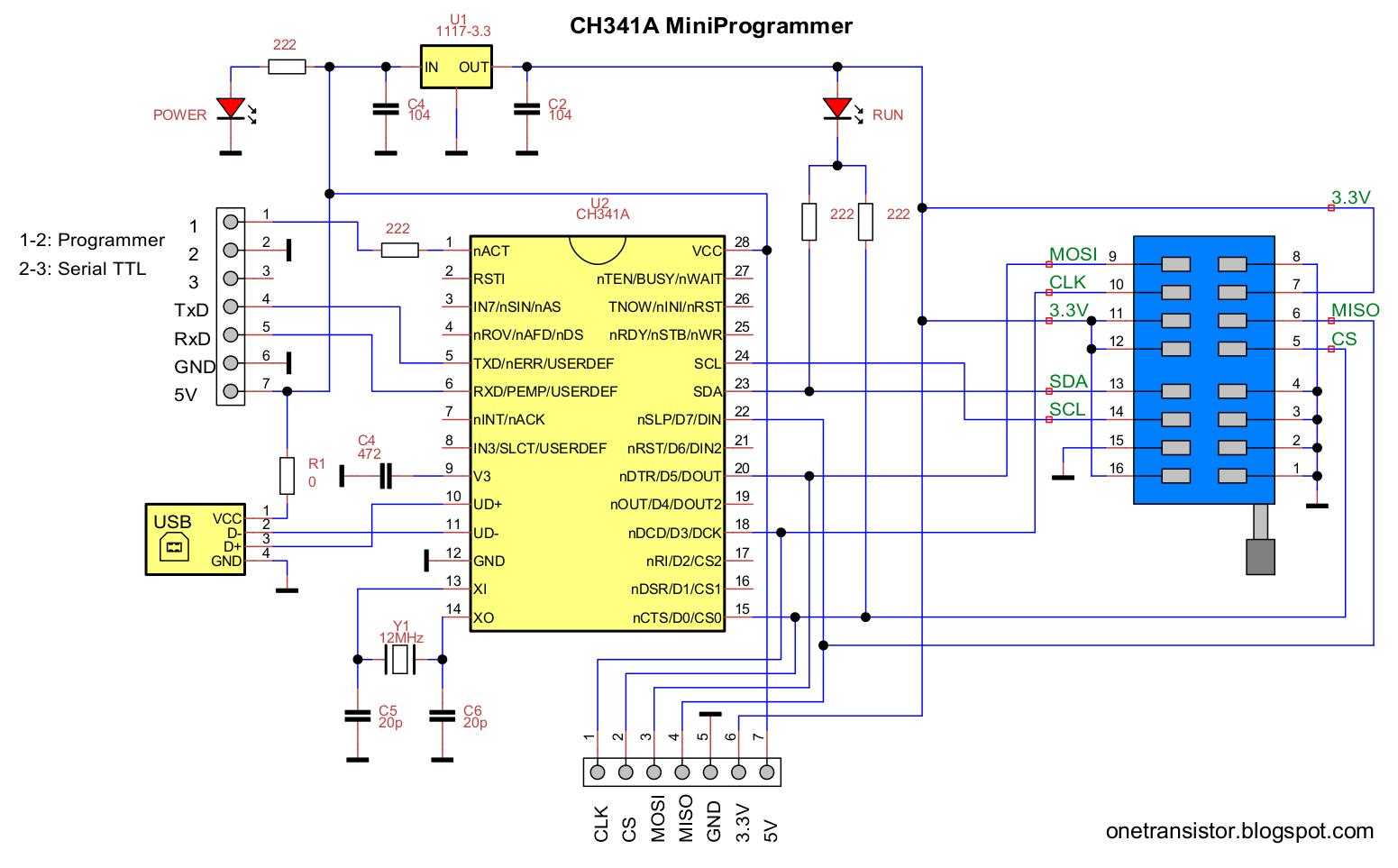
I purchased one cheap chinese CH341A serial memory space programmer dark PCB (see attached picture). Somebody already did the schematic of this table (atached). Resource: All Vcc contacts in the ZIF outlet are usually 3.3V but the CH341A can be driven at 5V. So all I2M and SPI indicators are usually 5V while the exterior memory can be driven at 3.3V. There are no limiting series resistors on those indicators.
One basic option to repair this issue is certainly to basically avoid the 1117-3.3V regulator. I can use the hot air train station to get rid of the 1117 and after that short-circuit the input with the output. My query is, is it safe to just perform the short-circuit without eliminating the 1117 linear regulator?